
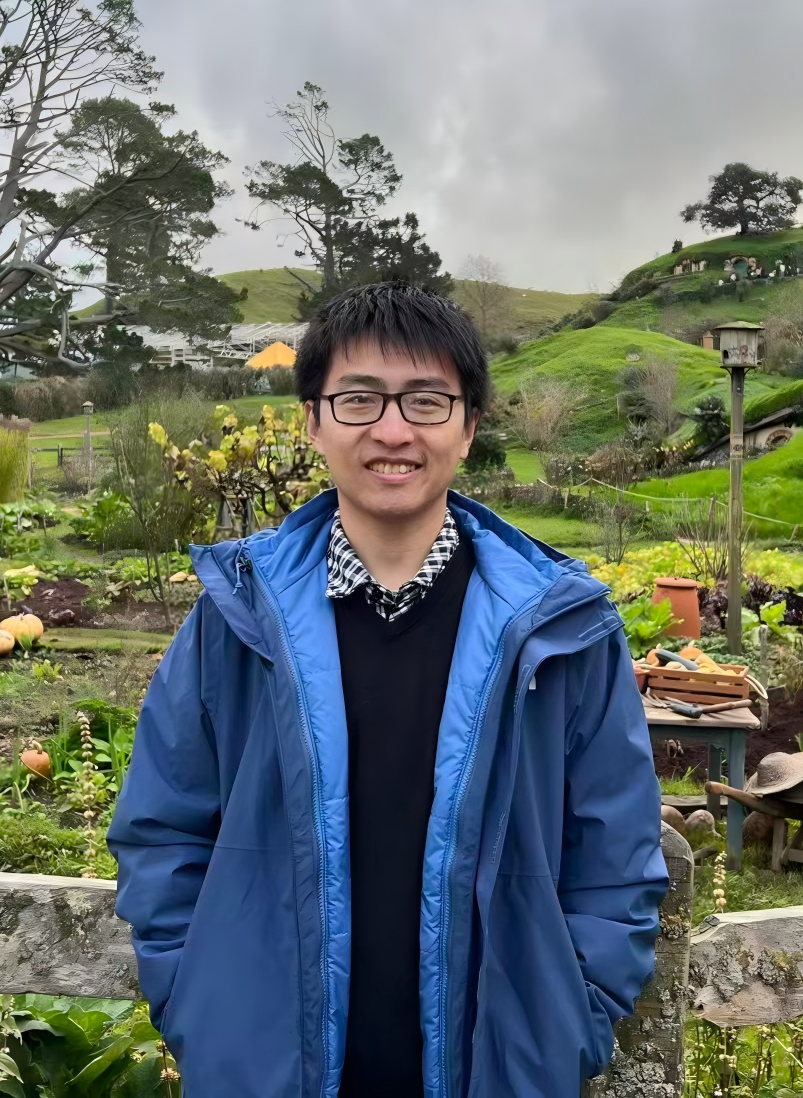
Liang Dai, Professor
Bio:
2011 – B.S. in Physics, Peking University
2015 – Ph.D. in Physics, Johns Hopkins University, USA
2015 – Awarded the NASA Einstein Postdoctoral Fellowship
20152020 – Postdoctoral Fellow, Institute for Advanced Study, Princeton, USA
2020–2026 – Assistant Professor, University of California, Berkeley, USA; Principal Investigator of projects funded by the U.S. Department of Energy and of multiple observational programs with the NASA/James Webb Space Telescope
2021 – Received the Sloan Research Fellowship
2026–present – Professor, Department of Physics, Fudan University; Member of the Fudan Center for Astronomy and Astrophysics
Has published over 100 papers in high-impact international scientific journals, with more than 6,500 citations.
Research Interests:
Extragalactic Astronomy: Theory and applications of strong and microlensing; intermediate- and high-redshift galaxies, star clusters, and star formation; physics of the interstellar medium
Cosmology: Dark matter, cosmic microwave background radiation, and searches for new physics (e.g., axions)
Multi-messenger Astronomy: Gravitational-wave sources and gravitational-wave signal detection
Selevted Publications:
[1] Massimo Pascale; Liang Dai; Brenda Frye; Aliza Beverage; Investigating Earendel as a Metal Poor Globular Cluster Progenitor at z ~ 6, Astrophysical Journal Letters, 2025, 988 (2): L76
[2] Liang Dai; Partially Ionized Gas at Equilibrium Powered by Ultraviolet Irradiation, Astrophysical Journal, 2025, 984(2): 175
[3] Weichen Winston Yin; Liang Dai; Junwu Huang; Lingyuan Ji; Simone Ferraro; New Probe of Cosmic Birefringence Using Galaxy Polarization and Shapes, Physical Review Letters, 2025, 134(161001)
[4] Massimo Pascale; Liang Dai; A Young Super Star Cluster Powering a Nebula of Retained Massive Star Ejecta, Astrophysical Journal, 2024, 976(2): 166
[5] Massimo Pascale; Liang Dai; Christopher McKee; Benny Tsang; Nitrogen-enriched, highly-pressurized nebular clouds surrounding a super star cluster at cosmic noon, Astrophysical Journal, 2023, 957 (2): 77
[6] Liang Dai; Jordi Miralda-Escudé; Gravitational Lensing Signatures of Axion Dark Matter Minihalos in Highly Magnified Stars, Astronomical Journal, 2020, 159(2): 49
[7] LIang Dai; Shun-Sheng Li; Barak Zackay; Shude Mao; Youjun Lu; Detecting lensing-induced diffraction in astrophysical gravitational waves, Physical Review D, 2018, 98(10):104029
[8] Tejaswi Venumadhav; Liang Dai; Jordi Miralda-Escudé; Microlensing of extremely magnified stars near caustics of galaxy clusters, Astrophysical Journal, 2017, 850(1): 49
[9] Liang Dai; Fabian Schmidt; Enrico Pajer; On separate universes, Journal of Cosmology and Astroparticle Physics, 2015, 10(059)
[10] Liang Dai; Marc Kamionkowski; Junpu Wang; Reheating constraints to inflationary models, Physical Review Letters, 2014, 113 (041302)
Selected Major Achievements:
1.Established the theory of extreme gravitational lensing magnification phenomena in extragalactic systems
2.Pioneered a method to probe dark matter on small scales using extreme lensing magnification of stars
3.Discovered topological phase shifts (Morse phase) in the gravitational lensing of gravitational waves
4.Discovered compact H II regions and nitrogen-rich chemical signatures in the formation of super star clusters