
From completing his undergraduate studies and pursuing advanced research abroad to independently leading cutting-edge projects, 38‑year‑old Dai Liang has been deeply engaged in cosmology and astrophysics for over a decade. In 2021, he opened a new avenue for dark matter detection using extreme gravitational lensing and received the Sloan Research Fellowship.
This year, after fifteen years of studying and working overseas, he chose to return to China and settle at Fudan University, becoming a Fudan Xianghui Young Scholar and a professor in the Department of Physics and the Center for Astronomy and Astrophysics at Fudan University. In the future, he will continue to clarify seemingly “useless” questions and open up new ways to uncover deeper mysteries of the universe, relying on Fudan’s fertile interdisciplinary ground.
The solar system and planets, distant galaxies, aliens arriving in huge spaceships… the magnificent and mysterious illustrations in his childhood encyclopedias formed Dai Liang’s earliest imagination of the universe, while the mathematics and physics training during his secondary school years laid a solid intellectual foundation for that imagination. In 2011, after receiving a B.S. in Physics from Peking University, Dai Liang went to the Johns Hopkins University in the United States for his Ph.D., and later conducted postdoctoral research at the Institute for Advanced Study in Princeton.
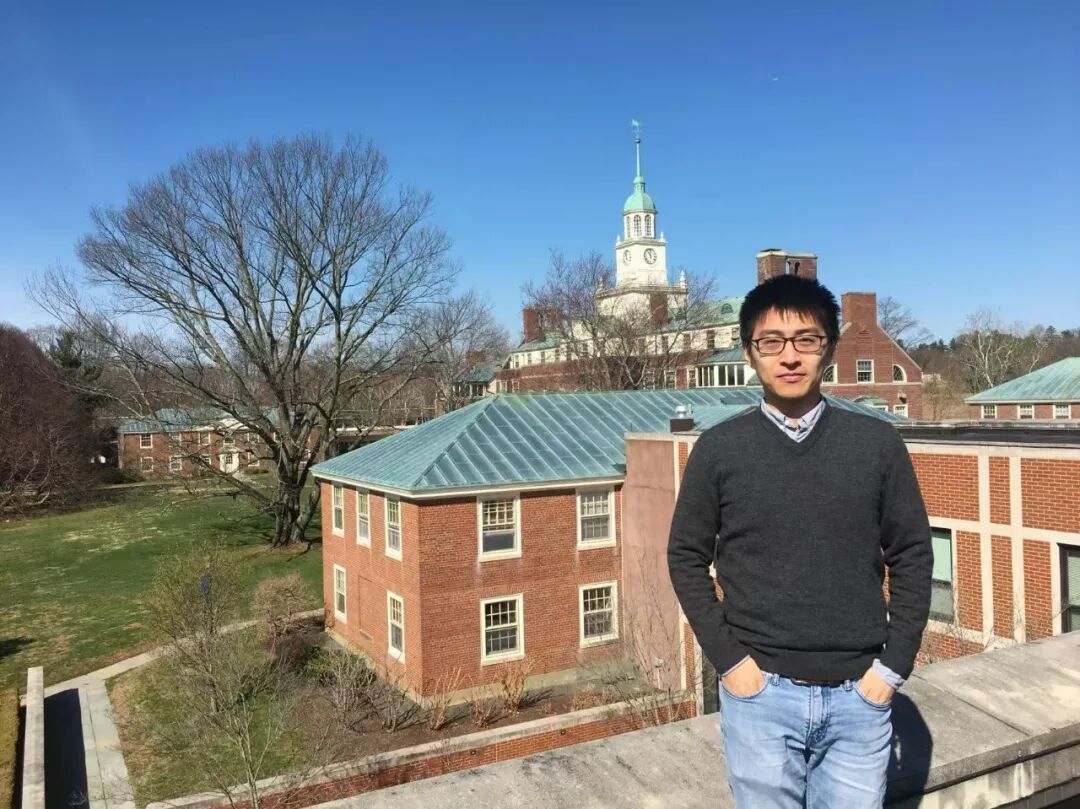
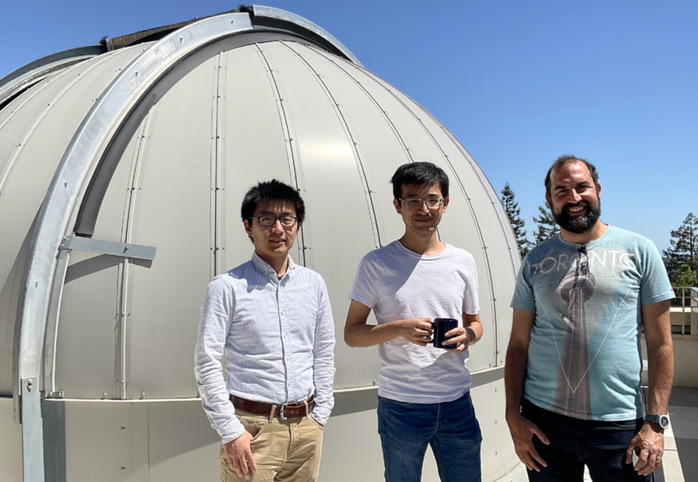
Dai Liang on the rooftop of the Institute for Advanced Study in Princeton, spring 2020.
In 2015, humanity directly detected gravitational waves for the first time. In 2021, the James Webb Space Telescope was successfully launched, ushering in a new era for astronomical research. Dai Liang happened to be at this turning point, transitioning from a student to an independent researcher. “I caught the golden age of the astronomical observation data explosion, with a vast amount of brand‑new cosmic phenomena waiting for us to mine and interpret.” The convergence of childhood interest, mathematical and physical thinking training, and rare research opportunities firmly set Dai Liang on the path of astrophysics and cosmology.

His research covers multiple topics in cosmology and astrophysics, with the most central being an imaginative tool—the “gravitational lensing effect.” It acts like a natural magnifying glass of the universe, bending and magnifying the light of distant stars that pass by it, allowing us to glimpse details otherwise lost in darkness.
More than 80% of the matter in the universe is invisible dark matter, and the microscopic nature of dark matter remains one of the core unsolved mysteries in physics. Previous studies of dark matter have focused on the large scales of galaxy formation, but Dai Liang was the first to develop a new approach, using extreme gravitational lensing magnifications in distant galaxies to probe the properties of dark matter on small scales, thereby deciphering the origin of dark matter in the primordial universe.
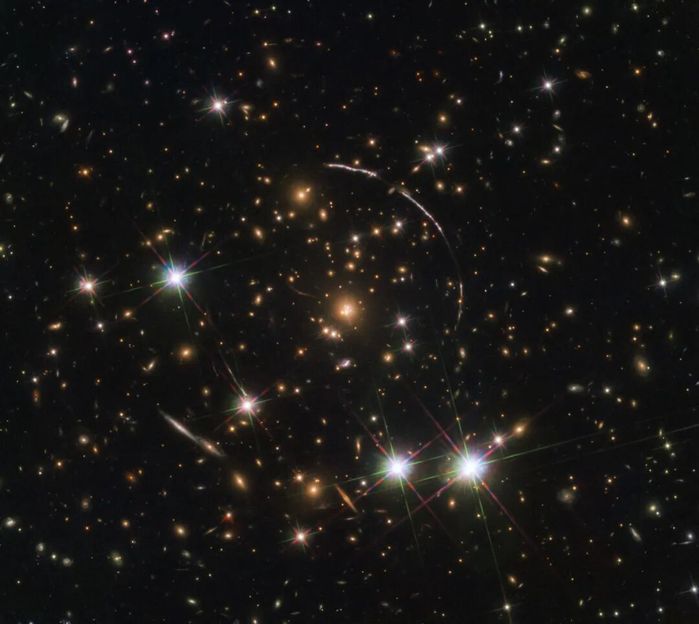
The Sunburst Arc galaxy at cosmic noon, magnified by gravitational lensing, as imaged by the Hubble Space Telescope.
Together with collaborators, he calculated various ways in which gravitational lensing distorts the paths of light propagation. From massive astronomical data, they screened and identified potential binary black holes, and further inferred the distribution of dark matter in the universe. “If we can find unexpected dark matter signals through extreme gravitational lensing phenomena, it would be like illuminating a new path for microscopic dark matter research.”
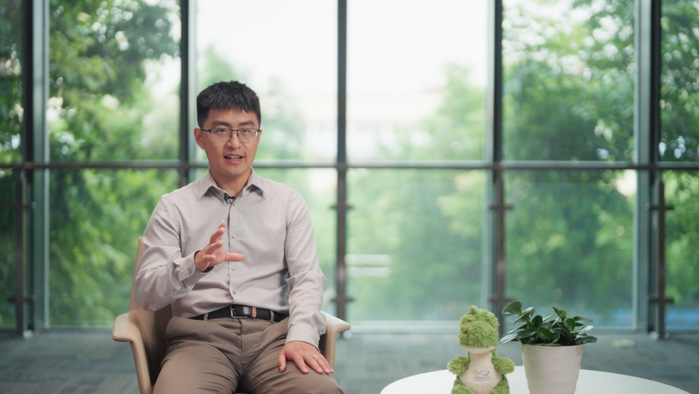
Interestingly, Dai Liang and his collaborators found that when gravitational waves are magnified by gravitational lensing, the gravitational waves exhibit fascinating phase shifts. This phenomenon, which is difficult to observe directly in light waves with experiments, can be clearly recorded by detectors that capture ripples in spacetime. In the future, if a gravitational wave signal is detected with a phase change, it can be determined that it has undergone gravitational lensing. With many original achievements in physical concepts and methodologies, Dai Liang, then an assistant professor at the University of California, Berkeley, won the Sloan Research Fellowship in 2021.
In Dai Liang’s view, current frontier research in cosmology still faces two major bottlenecks: one is observational technology, and the other is imagination. “Predicting physical phenomena in the universe that have not yet been discovered, based on existing physical laws, is a task that greatly requires imagination.”
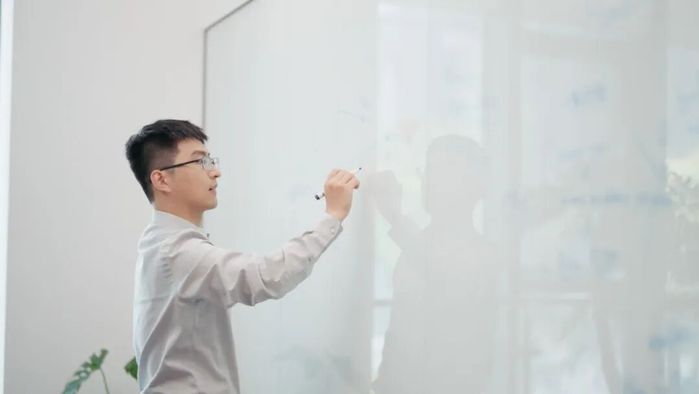
How to break through the bottleneck of imagination in research? Dai Liang’s answer is cross‑disciplinary communication and the collision of ideas. Combining gravitational lensing with dark matter research was itself a product of interdisciplinary cross‑fertilization.
At first, Dai Liang regarded extreme gravitational lensing merely as an interesting physical phenomenon, focusing on the physical principles of magnifying distant individual stars. It was only during exchanges with theoretical physics colleagues that he learned about particle physicists searching for a hypothetical particle called the “axion.” The introduction of this other perspective gave him a flash of inspiration: dark matter might indeed be composed of axions, which would form unique microscopic structures in the early universe, and gravitational lensing would be an excellent tool to probe those structures.
“Scholars from different fields view the same scientific question from completely different angles, and an casual conversation can give birth to entirely new research ideas.”
Coming to Fudan University, Dai Liang expects such collisions to become even more frequent. He looks forward to mutual inspiration and progress through exchanges with scholars from different disciplines at the university, as well as carrying out joint research and co‑supervising students.
Basic research requires a calm and steady “long‑term commitment.” Some questions may need decades or even centuries of observation to answer. “Scientific research does not suddenly discover the answer one day; on the road to the final answer, there are countless specific small problems to be solved. When you work on those specific problems, research is always motivating.”
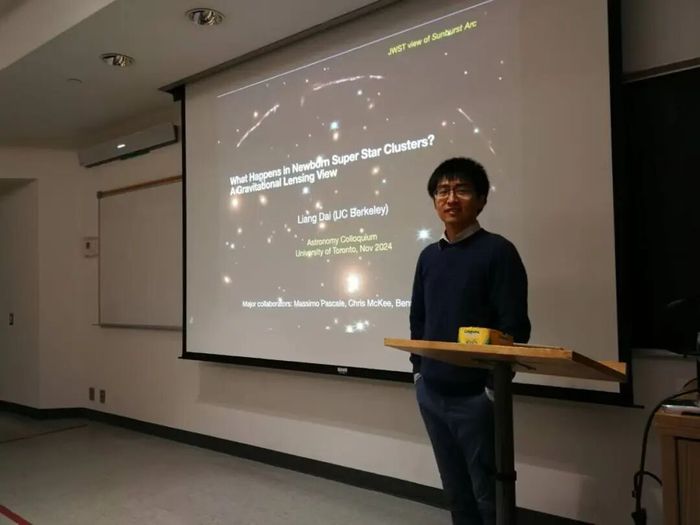
Dai Liang giving a colloquium at the University of Toronto in 2024.
He especially emphasizes the “usefulness of the useless.” “At the initial stage, it is often difficult to judge whether a piece of basic research is useful.” Dai Liang gave an example: as early as 30 years ago, some scholars predicted the existence of extreme gravitational lensing magnification in the universe, but leading experts in the field thought the phenomenon had no observational prospects.
In 2016, when humanity first observed an individual ancient star magnified by extreme gravitational lensing using the Hubble Space Telescope, most scholars still regarded the phenomenon as interesting but probably of little practical value. Five years later, Dai Liang’s work gradually made colleagues realize that it could be used to probe dark matter and study the origin of the universe. “If we take ‘usefulness’ as the sole criterion for research from the very beginning, we will miss many opportunities for deep thinking.”
Why choose to return to China? Why Fudan? Dai Liang mentioned a key phrase: “a historical opportunity.” In recent years, Chinese astronomy has developed rapidly, the level of young scholars has risen quickly, and more and more students have become deeply interested in astronomy. In his interactions with domestic students, he found that many students with solid mathematical and physical foundations are not fully trained due to limited research conditions. “After returning to China, I very much hope to give these promising students more opportunities for growth through research guidance and collaboration.”
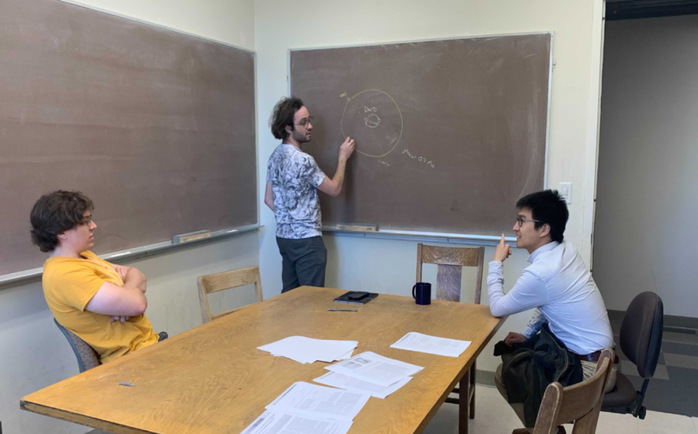
In 2024, the Center for Astronomy and Astrophysics at Fudan University was officially inaugurated, completing the disciplinary puzzle of astronomy at Fudan. Although there is no long‑standing disciplinary accumulation, Dai Liang sees this instead as greater space for innovation. He hopes to closely integrate the latest international research progress and China’s new generation of astronomical observation projects to design and develop new research directions. “These directions may lead to major discoveries, or they may be dead ends—but research inherently requires the courage to face the unknown and to dare to make mistakes.” He looks forward to carrying out some “unrestrained” explorations together with other scholars at Fudan.
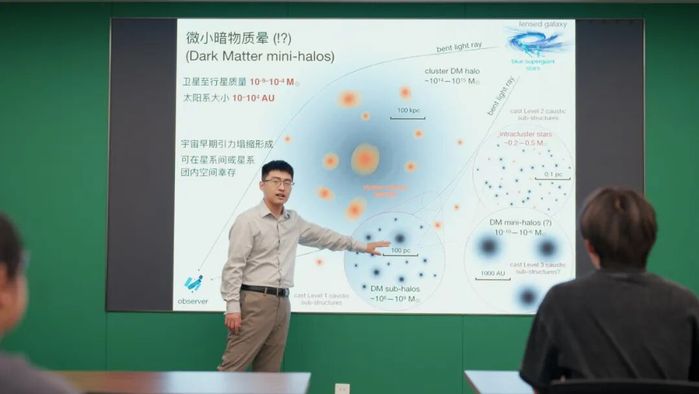
In the future, Dai Liang will continue to delve deeper into gravitational lensing research. In addition to probing the nature of dark matter, he is also interested in using gravitational lensing magnification to observe distant celestial bodies in the early universe and to decipher the origin and evolution of galaxies, stars, and black holes. As a teacher with many years of teaching experience, Dai Liang also looks forward to nurturing more young people who “look up at the stars” at Fudan. In his view, research can easily make one “see the trees but not the forest,” while teaching can force one to step out of the comfort zone. Preparing lectures itself is an efficient form of deep learning. “I warmly welcome students with a strong interest in astrophysics to explore interesting and unknown frontier topics in the universe together.”
From a child who daydreamed over encyclopedias to a scholar now seeking the ultimate answers of the universe, Dai Liang has spent more than thirty years on this journey. And those ultimate answers about dark matter and the origin of the universe still lie hidden in the distant starlight, waiting to be gradually illuminated by the “magnifying glass” gifted by the cosmos.